
Well-rounded, highly developed soft skills are invaluable to business success in this digital era but what are they and why are they important? While soft skills can at times be more difficult to develop than hard skills, they are arguably equally important for success in business. Hard skills concern an employee’s ability to do a specific task and include specialized technical abilities. Soft skills are more about the way they are done — how they adapt, collaborate, solve problems, make decisions and cognitive skills.
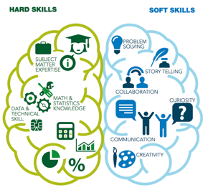 In most jobs, technical skills alone are not enough to be truly effective. A lack of soft skills can limit your potential, or even be the downfall of a business. Earlier this year LinkedIn released a list of the five most in-demand soft skills for 2020 comparatively with the technology, sales and digital hard skills such as Blockchain on the rise. We give individual focus to these skills and assess how to improve them.
#1 Creativity and innovation
Creativity means to creatively approach problems and tasks across business. Bringing new ideas to the table and thinking outside of the box. Alex Gray, from the World Economic Form explains that as a result of new technologies and products, employees are going to have to become more creative in order to benefit from these changes. Creativity can be improved by taking time to let your thoughts wander. Also, making it a habit to sit down and work when you’re sleepy. Research has shown that when you are sleepy, your brain is unfocused, therefore less inhibited and innovation flows.
#2 Persuasion and influence
It is important to continuously advance your career by developing your ability to effectively communicate ideas and persuade your colleagues and stakeholders that it’s in their best interest to follow your lead and ideas. The WEF stated that having persuasion and social skills will be more important than ever in the future. Although we live in a world of technology, people are still far better at social interaction than robots are, currently. The key to gain influence and improve your persuasion skills is to understand what motivates your audience. Once you establish this it would be easier to find a common ground benefiting all. Another way is to state the facts and emphasise the benefits it would have for all the participating parties.
#3 Collaboration and social impact
Companies are putting more emphasis on strong interpersonal skills, and employees who play well with others. Collaboration is crucial in any work environment. The WEF report explained that human interaction in the workplace involves team production, with workers playing off of each other’s strengths and adapting flexibly to changing circumstances. Collaboration involves strong communication skills, an awareness of other people’s strengths and weaknesses, and being able to work with a range of different personalities. It is therefore important to learn how your strengths can complement those of your colleagues to reach a common goal. Completing assessments for insight into yourself, your leaders and your team members.
#4 Adaptability and cognitive flexibility
Adaptability is changing or create modifications in oneself to suit new environments. In workplace culture, it means to be open to new ideas or changes, the ability to work independently or in teams. People who are adaptable have more chances of having better job satisfaction, they are co-creators of their lives. In the long-term links form between adaptability and job performance. One way of developing adaptability is to practise emotional intelligence. According to research on flexibility and adaptability, people with a higher EI adapt swiftly to new changes. Other ways are to take a broader variety of perspectives into consideration and consider the bigger picture. One could also embrace different situations and view challenges as opportunities, mindset change is a game changer.
#5 Emotional Intelligence
Emotional intelligence is the ability to perceive, evaluate, and respond to your own emotions and the emotions of others. Co-author of Emotional Intelligence 2.0, Travis Bradberry explains that emotional intelligence ‘is the other kind of smart.’ It’s that intangible ‘something’ that helps us tune into the kaleidoscope of human emotions, and measures how adept we are at adjusting our behaviour depending on the mood of a colleague, partner, family member, or our own internal feelings. Emotional intelligence can be gained and improved at any point in life. We at The People Shop have seen the tangible improvement in employee engagement, resilience and stress management and its effect on business productivity, success and business’ revenues and bottom-line.

